The 80 20 Couch
In essence, the Pareto Principle states that 80% of outcomes results from 20% of causes. While this may be true in a lot of cases, sometimes the principle breaks down.
One semester of my time at MIT, I was assigned to live in a particularly small room. This wasn't your ordinary small single at a dorm. the room was literally 6' 6" wide. I was within 3 inches of being able to touch both walls at the same time, and the longest dimension in the room was its vertical height -- about 14 feet tall at its tallest, though a slanted ceiling meant that the shorter part of the room was only about 8 or 9 feet tall. A loft about 7 feet up effectively divided the space up into a lower living area and an upper sleeping area. Despite the loft, it was a tight room to live in.
Of course, the tight living quarters were not going to get in the way of me making my room inviting, so I decided that what the room needed was a couch. Unfortunately for me, I spent a while scouring the internet for a couch of the appropriate dimensions to fit into this room, but with a very limited space (24"x60" of dedicated floor space for the couch), no premade couches came close to fitting. I decided instead to try my hand at carpentry and make my own couch, but perhaps I had too much hubris because I decided not to look up instructions.
The first thing I constructed was the frame for the sitting area. I decided to stretch webbing across it in a grid pattern to give the couch some bounce, so I made a frame out of 4x4s with the front and back pieces set lower than the sides. Then, I cut three notches into a scrap piece of wood to make a simple webbing tensioner, and used a staple gun to fasten webbing to the frame. At first, it seemed to be fine, but as I fixed more and more of the webbing, I discovered the force of each strap I added was causing the previous ones to become looser due to slight wood warp. So I undid most of them and retensioned them starting at a slightly higher tension and decreasing the tension of each subsequent strap slightly. It ended up being a mostly comfortable seat, except that the front piece of wood was a bit too low, and made front webbing surface curve down too much.
At this point, I had already been living couch-free for a couple weeks and was really looking forward to finishing this project, so in one day, I added legs and a back, all simply made of wood. Since I was rushing to finish, I put all the legs fully vertically, forgetting that the aforementioned curve at the front of the webbing surface made the entire sitting area effectively slant forward. This was quite unpleasant, but I didn't want to dismantle the couch and put it back together, so I simply tilted it back by putting stuff under the front legs. This kind of worked, but made the couch's center of balance fall pretty close to the back legs since there was also the heavy all-wood back panel pulling the couch backward. For the rest of the semester, I lived with this couch in this half-decent state: good enough not to bother fixing, but not good enough to be fully satisfied.
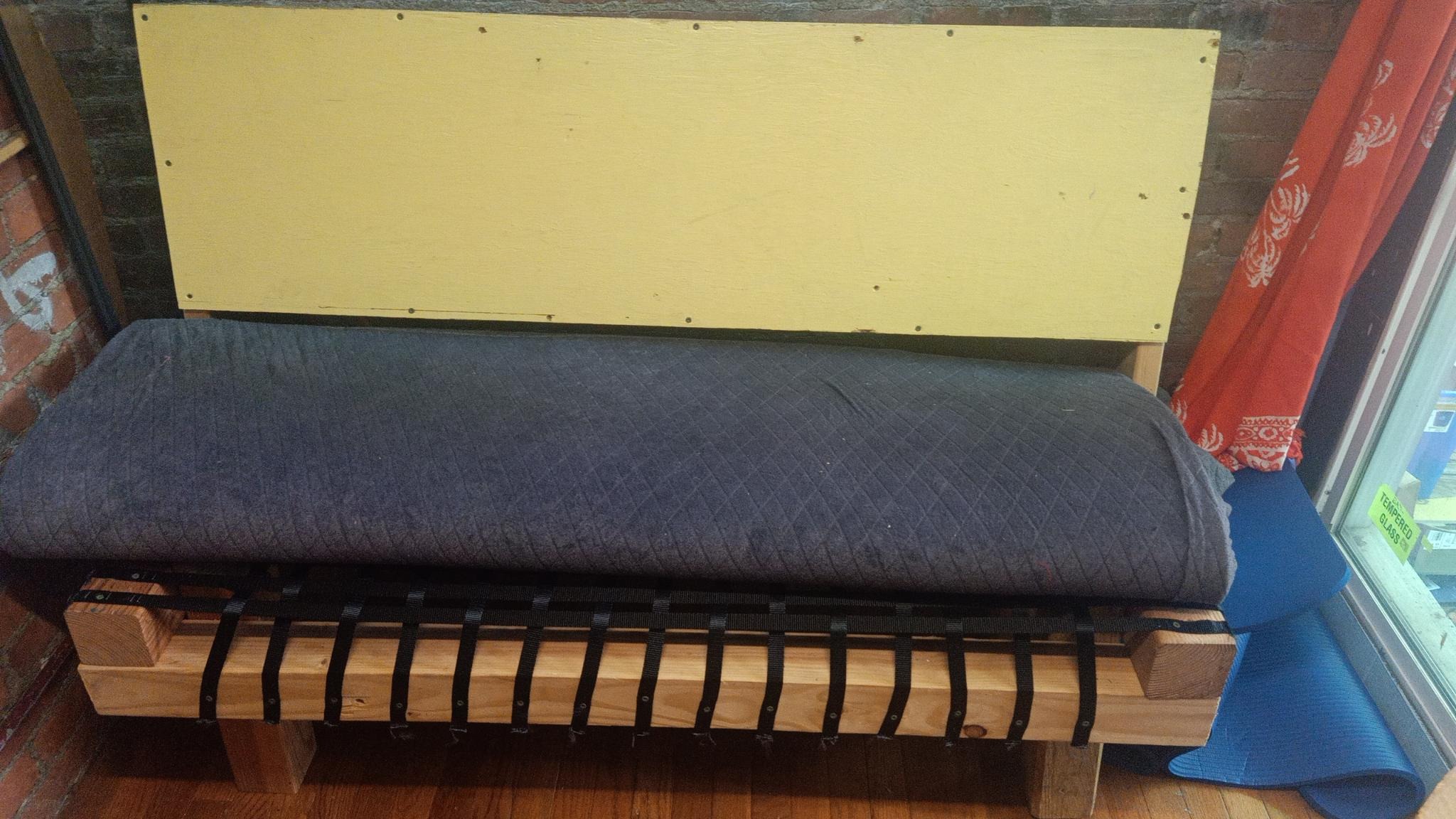
I think this project illustrated the Pareto Principle to me quite well. I had done the 80% of the work that corresponds to 20% of the outcomes. Had I just spent that extra 20% on the smaller details of the couch, it would have been a wonderful little couch that perfectly suited the little room. But as it was, there was still an 80% left to be desired.